For multi-entity companies

AP and purchasing for multi-entity companies on Xero.

Derive brings purchasing, contracts, budgets and accounts payable for every entity into one place. The AP Agent prepares each invoice, and your team reviews and approves.

See Derive in action
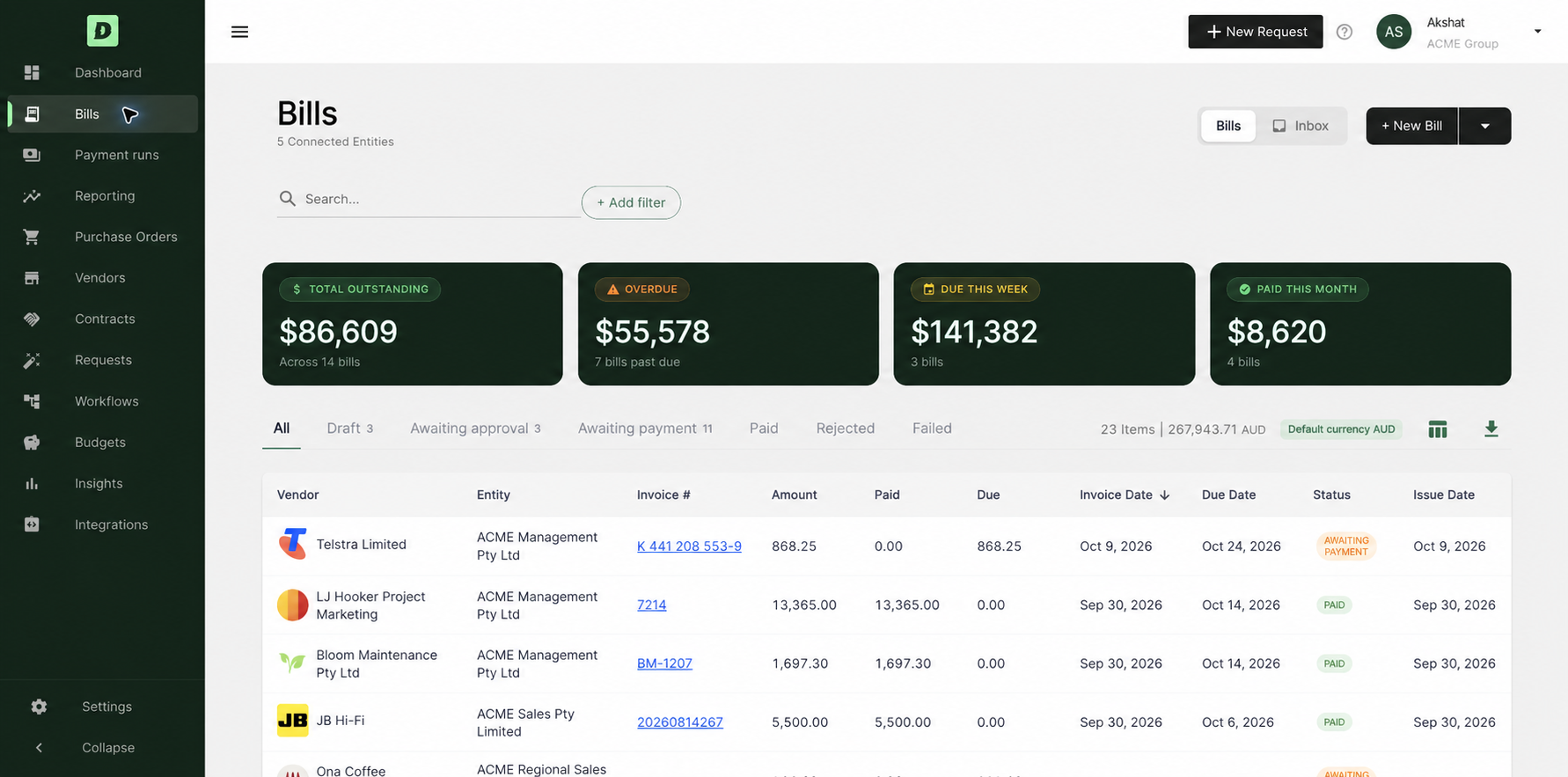
Derive’s Bills screen across 5 connected entities: $86,609 outstanding across 14 bills, $55,578 overdue, and the register of bills by vendor, entity and invoice number.

The problem

Group finance teams work one Xero file at a time, keying, chasing and checking invoices by hand.

These are common problems they face, and where Derive comes in.

Day to day

Problem

Every invoice starts with a lookup

Which entity, which supplier, which coding and tax treatment. Switching entities all day is like switching boards in Jira. Each switch costs a little, and the cost repeats on every invoice.

With Derive

The AP Agent matches the supplier and entity and prepares the coding from instructions kept per supplier and per entity. Your team reviews it.

Problem

Invoice data is keyed in by hand

Invoices arrive in an AP inbox and are opened, keyed, coded and filed, one entity at a time.

With Derive

Every entity’s invoices land in one inbox. The AP Agent extracts the details before your team opens the invoice.

Problem

Group payables are hard to see

Each entity’s invoices sit in its own file, so seeing what the group owes means building the picture by hand.

With Derive

Group finance sees every active invoice across the group from one screen. Entity managers see only their own.

Problem

Payment runs are built file by file

Paying suppliers across the group means batching in each file, week after week.

With Derive

Payment runs prepare a group-wide batch through one front door, for your team to review before anything is paid.

The approvals and the budget

Problem

Approvals wait without context

Invoices sit in an inbox until the approver has time, and arrive as a PDF with no context. Finance follows up.

With Derive

Invoices route by entity, amount and category. The approver sees the invoice, its source email, the checks and the budget beside it.

Problem

The budget position is unknown at approval

Budgets sit in spreadsheets, so an overspend shows up after month-end.

With Derive

Budget impact shows when a request is raised and again when the invoice arrives.

Problem

Commitments are made before finance hears about them

Purchase requests sit in email and agreements sit in an inbox, so an auto-renewal arrives as an invoice.

With Derive

Requests, purchase orders and contracts connect to the invoices that follow, and renewal dates stay visible.

The expensive mistakes

Problem

The same invoice can reach two entities

It gets processed in two files, and each file looks fine on its own. The duplicate comes to light weeks later, if it does.

With Derive

Derive sees every entity at once, so it can flag an invoice sent to more than one.

Problem

A changed bank detail is easy to miss

With a high volume of invoices across entities, it is hard to check every bank detail, and invoice phishing relies on that.

With Derive

Derive sees every entity at once, so changes stand out across the group.

Who it’s for

Group businesses running 5–50+ legal entities, each on its own Xero file, with a lean finance team. The pain looks much the same in every sector, and it shows up most in these:

Roxanne O'Sullivan
24 Xero files. One Derive inbox.
Roxanne O'Sullivan CFO, Amalgamated Property Group
Story coming soon

Trusted by top finance teams running groups

  • Amalgamated Property Group
  • CyberCX
  • Anytime Fitness
  • Spark Renewables
  • Prezzee
  • Metro Finance
  • Sammut
  • Horizon Accounting Group

Explore our products

FAQ

What is multi-entity accounts payable?

Multi-entity accounts payable is the process of receiving, coding, approving and paying supplier invoices for a group of separate legal entities. It is harder than single-entity AP because each entity usually has its own accounting file, so every bill has to be matched to the right entity before anything else can happen.

How do you manage accounts payable across multiple Xero entities?

Most groups either work file by file or add a tool for each entity. Derive connects to each entity’s Xero file and brings the bills into one inbox, where the AP Agent prepares them for review. Approved bills post to the right Xero file.

Can you detect duplicate invoices across entities?

Yes. Derive sees every entity at once, so it can flag an invoice sent to more than one entity, based on matching invoice numbers, amounts or billing details. A tool that sees only one Xero file cannot.

Do you need an ERP to control spend across entities?

Not for purchasing and payables. Groups often consider an ERP because spend gets hard to control across entities. If what you need is purchasing, payables, contracts and budgets rather than consolidated statutory accounts, Derive adds that control on top of Xero.

Does Derive do consolidated reporting or intercompany eliminations?

No. Derive covers purchasing and payables, and it sits alongside the tools you use for consolidation and intercompany work.

Does the AP Agent approve invoices?

No. It prepares each bill for review. Your team approves it.

See how Derive would run across your entities.

See Derive in action